The moon runs on a schedule you can keep from your own driveway. One full cycle, from new moon back to new moon, takes 29.53 days. Give it a single season, say October through December 2026, and you get three complete cycles of the same landscape re-lit, night after night. Here’s how to follow one of them from start to finish.
Week 1: the crescent and earthshine
Photo by [Dijanynni Kiratza](https://www.pexels.com/@dijanynni-kiratza-235375981) on Pexels
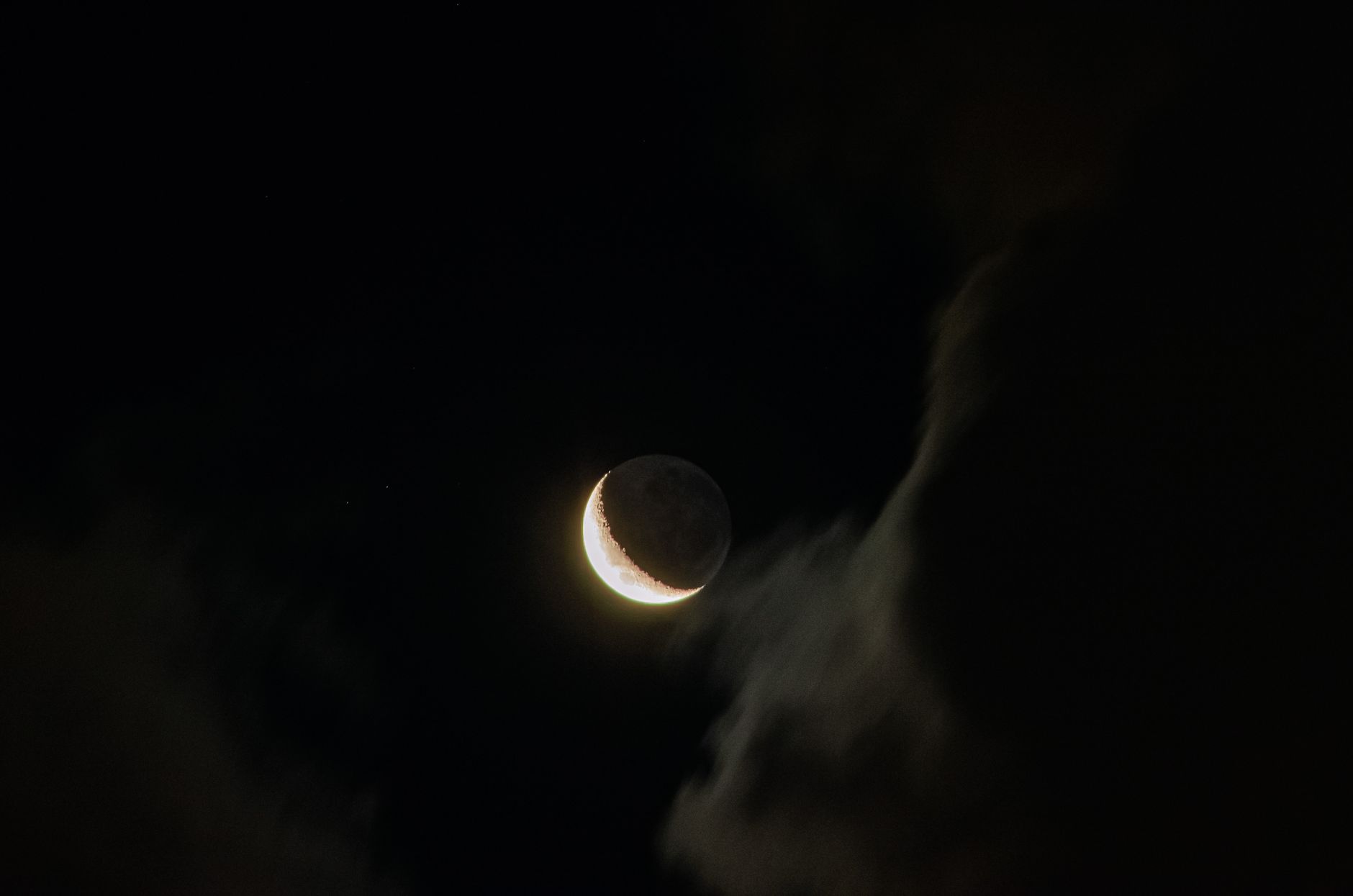
Two or three evenings after new moon, look low in the west just after sunset. You’ll find a thin crescent, maybe four percent lit. Look at the dark part anyway. It glows faintly, a ghostly gray disk beside the bright sliver. That glow is earthshine, sunlight bouncing off Earth’s clouds and oceans and lighting up the moon’s night side. Leonardo da Vinci worked out the cause around 1510 in the Codex Leicester, and the modern account is spelled out on Wikipedia’s earthshine page. It’s brightest in April and May, but almost any clear crescent evening shows some.
Week 2: the shadow line
Photo by [naturepost](https://pixabay.com/users/naturepost-1467357) on Pixabay
By day seven or eight the moon is half lit and high at sunset. Now the terminator, the boundary between lunar day and night, runs straight down the middle of the disk. The sun sits low along that line, so every crater rim throws a shadow many times longer than the wall is tall. A pair of 7×50 binoculars braced on a fence rail is plenty. Sweep slowly along the terminator and watch a crater catch light on one rim while its floor stays black. Keep going until you spot a bright peak standing alone in the darkness.
Week 3: toward full
Photo by [gigolonim](https://pixabay.com/users/gigolonim-10729107) on Pixabay
Waxing gibbous nights, roughly day ten to thirteen, trade drama for coverage. Shadows shorten as the sun climbs higher, but terrain you haven’t seen yet rolls into view along the eastern edge, including Mare Crisium, the isolated dark oval near the limb. Then comes full moon, and the sun hits the surface almost straight on. The craters fade into a wash of glare and the whole disk flattens. Treat that night as a rest. Watch it rise anyway, and notice that it comes up just as the sun sets.
Week 4: the light turns around
After full, the terminator reappears and walks back across the disk the other way. Now shadows point the opposite way from week two, and the crater you studied then lights up from the other side. Worth a look on its own. In the final mornings before new moon, slip out before sunrise and you’ll catch a thin waning crescent with earthshine back on its dark side.
Keep a simple log
A cheap notebook and a red flashlight beat any app here, because the writing slows you down just enough to see. Three lines per session: date and time, what the phase looked like, and one detail you noticed. Add a pencil sketch of a single crater if you like; circles and rough shading are enough. Ten or twelve entries across the 29.53 days and you’ll have the whole cycle on paper, your crater caught in shadowless noon light and in long dawn shadow. Phase times shift with your location, and you can look each one up in advance on Wikipedia’s lunar phase page.
Start tonight, whatever phase is up. One season from now the moon will feel less like a lamp and more like a place you know.
Is There a Lunar Eclipse Tonight (And How to Find Out)
You can check whether a lunar eclipse is happening tonight in about 30 seconds. A handful of reliable tools track every upcoming eclipse with precise timing, and once you know where to look, you’ll never miss one again.
Maybe you stepped outside and noticed the moon looking unusually dim or tinted red. Or perhaps a friend mentioned something about an eclipse and you’re wondering if it’s tonight. Either way, here’s exactly how to find out.
The fastest way to check right now
Photo by [Brett Jordan](https://unsplash.com/@brett_jordan) on Unsplash
The quickest method is to visit timeanddate.com/eclipse and look at their lunar eclipse calendar. The site lists every upcoming eclipse with dates, times, visibility maps, and which phases you’ll see from your location [1].
If there’s an eclipse happening right now, the homepage will show it prominently. If not, the next one is usually just a click away.
NASA’s eclipse page at eclipse.gsfc.nasa.gov is another excellent resource. Their “Five Millennium Canon of Lunar Eclipses” covers every lunar eclipse from 1999 BCE to 3000 CE, though you’ll mostly care about the upcoming ones [2].
Apps that track eclipses for you
Photo by [pixifant](https://pixabay.com/users/pixifant-2995268) on Pixabay
Several astronomy apps send notifications before eclipses happen, so you don’t have to keep checking manually.
Stellarium (free, available on iOS, Android, and desktop) shows you exactly what the sky looks like from your location at any given time. You can fast-forward to future dates and watch how the moon’s appearance changes during an eclipse. It’s particularly good for understanding which phases of the eclipse will be visible where you live [3].
SkySafari (paid, iOS and Android) includes detailed eclipse predictions and augmented reality features that let you point your phone at the sky and see what’s coming. Its notification system alerts you a day or two before any significant astronomical event [4].
The NASA app (free, iOS and Android) sends push notifications for major astronomical events, including lunar eclipses. It’s not as detailed as dedicated astronomy apps, but it’s reliable and lightweight [5].
Understanding what you’re looking at
Photo by [silviarita](https://pixabay.com/users/silviarita-3142410) on Pixabay
Not all lunar eclipses are the same. There are three types, and knowing the difference helps you decide whether it’s worth staying up late or waking up early.
A penumbral eclipse is subtle. The moon passes through Earth’s outer shadow (the penumbra) and dims slightly. If you’re not paying attention, you might not even notice. These happen more frequently but are less dramatic [6].
A partial eclipse is more obvious. Part of the moon enters Earth’s inner shadow (the umbra) and takes on a dark, reddish-brown color on one side. You’ll definitely see this one without needing any special equipment.
A total lunar eclipse is the showstopper. The entire moon passes into Earth’s umbra and turns a deep red or copper color. This is the “blood moon” you see in headlines. Total eclipses are less common, happening roughly once every 2.5 years on average [7].
When the next lunar eclipses happen
Photo by [Farzad Mohsenvand](https://unsplash.com/@farzadme) on Unsplash
The next few lunar eclipses visible from various parts of the world include:
March 3, 2026: Total lunar eclipse, visible from Europe, Africa, Asia, and Australia [8]
August 28, 2026: Total lunar eclipse, visible from the Americas, Europe, and Africa [8]
February 20, 2027: Penumbral lunar eclipse, visible from the Americas, Europe, and Africa [8]
These dates come from NASA’s eclipse predictions, which are calculated centuries in advance using precise orbital mechanics. The timing is accurate to within seconds [2].
What to expect during a total eclipse
Photo by [Nandita Damaraju](https://unsplash.com/@ndam) on Unsplash
A total lunar eclipse unfolds over several hours. The partial phase begins when you first notice a dark “bite” taken out of one edge of the moon. Over the next hour or so, the shadow spreads across the lunar surface.
Totality, when the moon is fully inside Earth’s shadow, typically lasts between 30 minutes and 100 minutes depending on how centrally the moon passes through the shadow. During totality, the moon doesn’t go completely dark. Instead, it glows a reddish color because Earth’s atmosphere bends some sunlight around the planet and into the shadow [9].
The exact shade of red varies from eclipse to eclipse. Volcanic eruptions and atmospheric conditions can make the moon appear anything from bright copper to a deep, dark maroon. The 1991 eruption of Mount Pinatubo, for instance, made the following year’s eclipses notably darker than usual [10].
You don’t need special equipment
Photo by [Ann](https://unsplash.com/@ann10) on Unsplash
Unlike solar eclipses, lunar eclipses are completely safe to watch with your naked eye. No special glasses, no filters, no precautions needed. Binoculars will give you a closer look at the color changes and surface details during totality, but they’re optional.
A camera with manual exposure settings can capture the event, though the dim moon during totality requires longer exposures than the bright full moon you’re used to photographing.
The best viewing conditions are clear skies away from city lights, but even from urban areas, a total lunar eclipse is visible and impressive. The moon is bright enough during totality to cut through moderate light pollution.
Sources:
[1] Time and Date, “Lunar eclipses,” timeanddate.com/eclipse/
[2] NASA Goddard Space Flight Center, “Eclipse predictions,” eclipse.gsfc.nasa.gov
Small optics companies face a surprisingly complex financial puzzle when they sell telescopes overseas. A refractor built in a workshop in Japan might ship to an amateur astronomer in Brazil, a university in South Africa, or an observatory in New Zealand. Each sale crosses borders, currencies, and banking systems that weren’t designed for niche hardware businesses.
If you’ve ever ordered a custom telescope or high-end eyepiece from another country, you’ve probably noticed the shipping costs. What you might not see is the financial friction happening behind the scenes for the manufacturer.
The payment problem nobody talks about
Photo by [janggagye](https://pixabay.com/users/janggagye-8920763) on Pixabay
Telescope and optics manufacturers occupy an unusual space in global commerce. They’re not moving millions of units like consumer electronics brands. They’re often small teams, sometimes just a handful of people, crafting precision instruments that sell for anywhere from a few hundred to several thousand dollars.
That creates a specific set of payment challenges. Traditional banks charge steep fees for international wire transfers, often $25 to $50 per transaction on each end. For a small optics company processing maybe 20 or 30 international orders a month, those fees eat directly into margins that are already tight [1].
Currency conversion adds another layer. When a telescope maker in Taiwan receives payment in euros, the bank’s exchange rate typically includes a markup of 2 to 4 percent. Multiply that across dozens of transactions and the losses add up fast [2].
Why standard payment processors fall short
Photo by [Towfiqu barbhuiya](https://unsplash.com/@towfiqu999999) on Unsplash
You might think PayPal or Stripe would solve this. For many small optics businesses, they partially do. But there are complications.
PayPal’s currency conversion fees run around 4 percent on top of their standard transaction fees. For a $2,000 telescope, that’s $80 gone before the product even ships. Some manufacturers absorb this cost. Others pass it to customers, which can push price-sensitive buyers toward competitors [3].
Stripe works well for card payments but doesn’t handle bank transfers or local payment methods in many markets. A customer in Germany might prefer SEPA transfers. Someone in Japan might want to pay via bank transfer. A buyer in Brazil could need Boleto. Each payment method requires its own integration, and most small telescope makers don’t have the engineering bandwidth to support them all [4].
How specialized manufacturers are adapting
Photo by [ArtificialOG](https://pixabay.com/users/ArtificialOG-1886751) on Pixabay
The smarter optics companies have started using multi-currency business accounts that let them hold, receive, and send money in different currencies without constant conversion. This approach cuts out the repeated exchange rate markups that used to drain their accounts.
A business account designed for international commerce lets a telescope maker receive euros from European customers, hold those euros, and then use them to pay a glass supplier in Germany or a coating facility in France. The money stays in the same currency throughout much of its journey, avoiding unnecessary conversions [5].
This matters especially for optics companies because their supply chains are inherently international. A single telescope might use glass from Schott in Germany, coatings from a facility in Japan, mechanical parts machined in Taiwan, and assembly done in the company’s home country. Each of those supplier relationships involves cross-border payments.
The real-world impact on small optics shops
Photo by [Wildkraeuterreich](https://pixabay.com/users/Wildkraeuterreich-6245973) on Pixabay
Consider a hypothetical but realistic example. A telescope maker in the United States sells about 15 instruments per month internationally, averaging $3,500 each. That’s roughly $52,500 in monthly international revenue.
With traditional banking, they might lose 3 to 5 percent to a combination of wire fees, currency conversion markups, and intermediary bank charges. That’s $1,575 to $2,625 per month, or $18,900 to $31,500 per year [6].
For a small business with maybe two or three employees, that’s the equivalent of a part-time salary lost to payment inefficiency. It’s money that could go toward better glass, new tooling, or simply keeping the lights on.
Modern multi-currency accounts reduce those costs significantly. By receiving payments in local currencies and paying suppliers directly, many small manufacturers have cut their international payment costs by 60 to 80 percent [7].
What this means for the astronomy community
When telescope makers spend less on payment processing, the benefits ripple outward. Some companies reinvest in research and development, producing better optics. Others can afford to offer more competitive pricing, making quality instruments accessible to more people.
The amateur astronomy community benefits when the financial infrastructure supporting telescope manufacturing gets more efficient. It’s not the most exciting part of the hobby, but it directly affects what shows up at your door when you order that new apochromatic refractor.
If you run a small optics business or any niche hardware company selling internationally, it’s worth looking at how your payment infrastructure compares. The savings might surprise you.
Sources:
[1] Wise, “International wire transfer fees,” wise.com
A small backyard observatory, a shed with a roof that rolls off and a telescope mounted inside, is a real project with a real price tag. Materials, a decent mount, a camera, cabling, maybe a pier sunk in concrete. You can spend a few thousand dollars without trying hard. Most amateurs fund it themselves, piece by piece, and plenty of them find ways to make the hobby help pay for itself. Here’s the practical money side.
Start smaller than you think
The cheapest way to fund an observatory is to want less of it at first. You don’t need the finished dome on day one. Build in stages. A solid pier and a good mount matter more than a fancy enclosure, so put money there first and shelter the gear with a tarp while you save for the roll-off shed. Buy the mount new, because a stable mount is the heart of everything, and buy almost everything else used. The astronomy market is full of good secondhand cameras and eyepieces from people who upgraded.
Set a real budget and a timeline: a number, a date, and a monthly amount. This is the kind of project that stalls without a plan and moves fast once you have one.
Crowdfunding, if the project earns it
If your build has a hook beyond your own enjoyment, crowdfunding can work. The projects that get funded tend to give something back: a public livestream of the sky, an open dataset, an astronomy program for a local school, time on the scope for anyone who chips in. People fund a story and a purpose. A plain “help me buy a telescope” rarely lands. “Help me put a remote observatory online so any classroom can point it at Saturn” is a different pitch.
Keep the reward tiers simple and deliverable. A shout-out, a star party invite, a print of the observatory’s first image. Don’t promise anything that turns your hobby into a second job you resent.
Selling astrophotography prints
The most common way amateurs offset costs is by selling their images. Once the gear is pointed at the sky anyway, the photographs are a natural byproduct, and there’s a genuine market for large, framable prints of nebulae, galaxies, and the moon. This won’t make you rich, but it can cover consumables, the odd new filter, and chip away at the bigger purchases.
A few things that help. Print quality matters more than resolution bragging, so work with a good lab and sell physical pieces people hang on a wall. Local sells well: a striking print of the moon over a landmark near you moves faster than a generic deep sky object. And your best single image will outsell a big catalog of mediocre ones, so put your effort into a few standout shots.
Getting paid, including from buyers abroad
Once you’re selling prints or taking crowdfunding pledges, you need a clean way to actually collect the money, and a chunk of your buyers will be in other countries. Astrophotography has a global audience, so you want an overseas buyer’s payment to be as painless as a local one.
The practical setup is a single payment link or checkout you can drop into a post, an email, or a print listing, so a buyer taps it and pays in a couple of steps without you invoicing by hand. Look for a few things when you pick how to get paid. It should accept international cards and common local payment methods, so a buyer overseas isn’t blocked at checkout. It should handle the buyer’s currency cleanly, because a confusing total kills a sale. Fees and exchange rates should be clear up front, so you know what actually lands in your account. Sort this out before your first sale, so the moment someone wants a print you can send one link and be done.
Let the hobby compound
The money side gets easier over time in a way that mirrors the observing itself. Your first prints fund a filter. The filter improves your images. Better images sell more prints, which fund the roll-off roof, which lets you image on more nights. Small steps, each one paying for the next.
You don’t need a grant to build a backyard observatory. You need a staged plan, a bit of patience, and a couple of ways to let the sky help cover its own costs. Set up a clean way to get paid for your images and the observatory starts, slowly, to fund itself.
Step outside in a city and look up. On a clear night you might count a few dozen stars. Drive a couple of hours into the countryside, look up from the same clear sky, and there are thousands, plus a pale river of light arching overhead that turns out to be the Milky Way, our own galaxy seen edge on. Same sky, same stars. The difference is light pollution, and it’s quietly stolen the night sky from most of the people alive today.
What’s actually happening
Light pollution is the glow that artificial lighting throws into the sky. Streetlights, billboards, parking lots, and porch lights all send some of their light upward, where it scatters off dust and moisture in the air and creates a bright haze. That haze washes out faint stars the same way a lit room washes out a dim television screen. The brightest stars and planets punch through, which is why you can still see Orion and Jupiter from a city. Everything fainter drowns.
The cost is real. An estimated 80 percent of people in North America and Europe live under skies too bright to see the Milky Way at all. A whole natural sight that guided people for tens of thousands of years is now invisible to most of them, not because it went anywhere, but because we lit it out.
The Bortle scale
Astronomers rate how dark a site is using the Bortle scale, a 1 to 9 ranking. It’s worth knowing, because it tells you what to expect before you drive anywhere.
Class 1 is a truly dark site, so dark the Milky Way casts faint shadows and the sky is crowded with stars. You’ll find these deep in deserts and remote mountains. Class 4 is a rural or semirural sky, the Milky Way visible but not overwhelming, a realistic and rewarding target for most people willing to drive a bit. Class 7 to 8 is a city, where a handful of bright stars survive and everything else is gone. Class 9 is an inner city sky where you might see the moon, a planet, and almost nothing else.
Moving from a Class 8 city to a Class 4 rural site can take you from 30 visible stars to a couple of thousand. That single change does more for your view than any telescope you could buy. Aperture gathers light, but no amount of aperture removes the glow. Darkness is the upgrade.
Finding darker sky
You have a few options, and they stack.
The simplest is to drive. Use a light pollution map (several are free online) to find the nearest patch of darker sky and how far it is. For a lot of people a genuine improvement is only 30 to 60 minutes away. You don’t need pitch black to see a lot more. Even one step down the Bortle scale is a noticeable jump.
If you want the real thing, look up designated dark sky places. Organizations certify parks and reserves that protect their night skies, and these are Class 1 to 3 sites where the Milky Way is stunning. Many are public parks you can visit for free. A single night under a truly dark sky recalibrates what you think the universe looks like.
Wherever you go, protect your night vision. Your eyes take about 20 to 30 minutes in the dark to reach full sensitivity, and one glance at a phone screen resets the clock. Use a red flashlight or a red screen mode, because red light interferes least with dark adaptation. Then just wait, and watch the sky slowly fill in as your eyes adjust.
What filters can and can’t do
Filters get sold as a fix for light pollution, so it’s worth being straight about them. Certain filters, sometimes called nebula or narrowband filters, block the specific wavelengths that streetlights emit while passing the wavelengths that glowing gas clouds emit. On the right target, a nebula, from a moderately light polluted site, they genuinely help by darkening the background and lifting the contrast.
They have limits. They do nothing for stars, star clusters, or galaxies, which give off light across all colors, so a filter dims them right along with the sky glow. And no filter turns a city sky into a country one. Think of a filter as a modest boost for a specific kind of object, not a cure. The cure is still a drive to darker ground.
Start where you are
You don’t have to solve all of this at once. Learn the bright objects that survive city light first, the moon, the planets, the brightest clusters. Then plan one trip to a darker site and see the Milky Way for real. Once you’ve seen what a Class 3 sky holds, you’ll understand exactly what the glow was taking from you, and you’ll keep finding reasons to drive back out to the dark.
You don’t need a telescope for any of these. You need a clear night, a spot away from the worst of the streetlights, and about 20 minutes for your eyes to adjust. Here are 5 concrete targets to hunt down. Find all 5 and you’ve had a good month of looking up.
1. Jupiter and its moons
Jupiter is the brightest starlike point in the evening sky right now, a steady creamy white that doesn’t twinkle the way real stars do. That steadiness is the giveaway that you’re looking at a planet. Grab any pair of binoculars, brace your elbows on something solid, and look closely. You’ll see up to 4 tiny dots strung in a line beside it. Those are the Galilean moons, the same ones Galileo saw in 1610. Watch across a few nights and they visibly change position as they orbit.
2. The Pleiades
Look for a small, tight little smudge of stars, easy to mistake for a fuzzy patch at first glance. That’s the Pleiades, a cluster of young blue stars about 440 light years away. Most people can count 6 with the naked eye, sometimes 7 on a very dark night. Here’s the trick: look slightly to the side of it rather than straight at it. Your peripheral vision is more sensitive to faint light, so the cluster brightens when you don’t stare directly at it.
3. The Orion Nebula
Find Orion, the constellation with 3 bright stars in a short straight row forming the belt. Hanging below the belt is a fainter line of stars, the sword. Look at the middle “star” of the sword and it’s slightly fuzzy, not a sharp point. That fuzz is the Orion Nebula, a vast cloud of gas where new stars are being born right now, about 1,300 light years away. Binoculars turn the smudge into a soft glowing cloud.
4. A moon crater walk
Wait for the nights around first quarter, when the moon is half lit. Look along the line dividing light from dark, called the terminator. That’s where shadows are longest and craters stand out in sharp relief. Even steadied binoculars reveal dozens of them, plus the big dark plains called maria. A full moon washes all this out, so catch it at half.
5. The International Space Station
This one moves. The ISS passes over most places every few weeks, appearing as a bright, steady point sliding smoothly across the sky in 2 to 5 minutes, no blinking lights. It’s genuinely bright, often outshining everything but the moon. Check a free pass-prediction site for your exact location and it will tell you the minute it appears and which direction to face. Standing there watching a crewed spacecraft cross overhead never quite gets old.
Start with Jupiter, since it’s the easiest, and work down the list as the month goes. Each one you find makes the next easier, because you’re learning the sky as you go.
Most first telescopes end up in a closet. Someone spends a few hundred dollars, points the thing at the sky, sees a blurry smudge, gets frustrated, and gives up. The gear wasn’t always the problem. The expectations were. If you know what a telescope actually does and what the tradeoffs are before you buy, you’ll pick something you keep using. Here’s how to spend your money well.
Aperture is the thing that matters
Forget magnification. The number that actually counts is aperture, the diameter of the main lens or mirror. Aperture is how much light the telescope gathers, and light is everything when you’re looking at faint, far away objects. A bigger aperture shows you dimmer galaxies, more detail on the planets, and sharper craters on the moon.
Magnification is almost a distraction. You change magnification by swapping small, cheap eyepieces, so any telescope can technically reach high power. The catch is that a small telescope pushed to high magnification just gives you a big, dim, mushy image. The useful ceiling is roughly 50x per inch of aperture, and honestly you’ll spend most nights well below that. When a box brags about “525x power,” walk away. That’s marketing aimed at people who don’t know aperture is the real spec.
For a first scope, aim for at least 4 inches (100mm) of aperture. Six inches is a lovely sweet spot. More than 8 inches gets heavy and awkward for a beginner, and a big scope you don’t want to carry outside is worse than a small one you use every week.
The three main types
There are three common designs, and each trades something.
Refractors use a lens at the front, the classic long tube shape. They’re rugged, need almost no maintenance, and give crisp, high contrast views of the moon and planets. The downside is cost. Aperture in a refractor gets expensive fast, so a beginner refractor is usually small, around 70mm to 90mm.
Reflectors use a mirror at the back. You get far more aperture per dollar than any other type, which is why they’re the standard recommendation for beginners who want to see the most for their budget. The tradeoff is that the mirrors occasionally need aligning, a quick job called collimation that sounds scarier than it is.
Compound scopes (names like Schmidt-Cassegrain and Maksutov) fold the light path to pack long focal length into a short tube. They’re compact and versatile. They also cost more and can take a while to adjust to outdoor temperature before the image settles.
The mount decides whether you enjoy it
People obsess over the tube and ignore the mount, then wonder why observing is miserable. A shaky mount ruins everything. Every tiny bump sends the image wobbling for seconds, and at high power the object drifts out of view while you’re still trying to focus.
For a first telescope, the simplest good option is a Dobsonian. That’s a reflector sitting on a plain wooden base that swings left, right, up, and down, like pointing a cannon. It’s stable, cheap, dead simple, and it puts your whole budget into aperture instead of a fancy tripod. A 6 inch or 8 inch Dobsonian is the single most recommended beginner scope for good reason.
The alternative is a tripod mount. Alt-azimuth tripods move up-down and left-right, which is intuitive. Equatorial mounts tilt to match Earth’s axis so you can track objects with one smooth motion, but they confuse beginners and add weight. Skip the equatorial mount for now unless you already know you want to photograph the sky.
What about “GoTo” and app-driven scopes
Computerized GoTo mounts find objects for you. Type in a target, the motors slew the scope to it. They’re genuinely helpful under city skies where you can’t see enough stars to navigate. They also cost more, need batteries and setup each night, and can leave you dependent on the computer instead of learning the sky. A newer category of smart telescopes stacks images automatically and streams the view to your phone, which is impressive but sits at a higher price and is really a different hobby from looking through an eyepiece.
A realistic first setup
Here’s an honest recommendation. A 6 inch Dobsonian reflector, somewhere around 300 to 400 dollars, is the scope most beginners should buy. It shows Saturn’s rings, Jupiter’s cloud bands and 4 big moons, the phases of Venus, dozens of craters, and a good handful of star clusters and brighter galaxies. It needs no power, sets up in a minute, and lasts for years.
Add two things. A cheap planisphere or a free star chart app to find your way around. And patience with your own eyes, which take about 20 minutes in the dark to reach full sensitivity, so give them that time before you decide a night is disappointing.
Buy the aperture you’ll actually carry outside, put it on a stable mount, and keep your expectations pointed at the moon and planets first. Do that and your first telescope won’t end up in the closet. It’ll end up worn smooth from use.
You’ve seen it. A full moon rising over rooftops or the sea, huge and orange, like it drifted closer to Earth. A few hours later the same moon is high overhead and looks ordinary, small even. It feels like the moon shrank. It didn’t. The moon is the same size all night, and one hand can prove it.
First, the fact that trips everyone up. The moon does not change size as it climbs. If anything, it’s very slightly farther from you on the horizon, because you’re looking across the whole width of the planet to reach it instead of straight up. So the horizon moon is a hair smaller in reality, and yet it looks enormous. That gap has a name. It’s called the Moon illusion, and people have argued about its cause since ancient Greece.
The image on your eye never changes
The illusion happens in your head. The image of the moon that lands on your retina is the same size whether the moon is low or high. You can check this. Hold your arm straight out and stick up your pinky nail next to the rising moon. The nail more than covers it. Do the same thing hours later when the moon is high, and the nail covers the same amount. Your finger doesn’t lie. The moon never grew.
So why does the low moon look so big? Scientists still don’t fully agree, but the leading explanations point at the same thing. Your brain judges size using context, and near the horizon it has plenty to work with.
The role of the horizon
When the moon is high, it sits in an empty black sky with nothing around it. Your brain has no ruler, so it reads the moon as small and far. When the moon is near the horizon, it hangs above trees, buildings, hills, the edge of the sea. Suddenly there are familiar objects next to it, things your brain knows the real size of. Against that ruler of rooftops and distant trees, the moon reads as large.
There’s a related idea about the sky itself. People tend to perceive the dome of the sky as flattened, so the horizon feels farther away than the point straight overhead. If your brain thinks the horizon moon is farther but it fills the same space in your vision, it settles the conflict by deciding the moon must be bigger. Size and distance are tangled together in perception, and the illusion is what happens when they cross.
Try it yourself
The best way to break the spell is to remove the context. Next time a big orange moon is rising, turn your back to it, bend over, and look at it upside down between your legs. It sounds ridiculous. It works. With the familiar horizon scrambled, the illusion weakens and the moon looks its normal, modest size. Rolling a tube of paper and viewing the moon through it does the same thing, cutting out the trees and rooftops.
None of this makes the rising moon less worth watching. A giant amber moon coming up over the horizon is one of the best free shows in the sky, and knowing it’s an illusion doesn’t spoil it. The wonder is just happening in two places at once, out there in space and right behind your eyes.
Before anyone owned a watch, people told time by the sky. The stars wheel overhead in a slow, dependable pattern, and once you learn the pattern you can stand in your backyard and read direction, season, and roughly the hour, all with your bare eyes. No app, no gear. Just a little practice looking up.
Find north first
Everything starts with finding north, and in the northern hemisphere that means finding Polaris, the North Star. A lot of people expect the North Star to be the brightest one and go hunting for the wrong star. Polaris is fairly ordinary in brightness. What makes it useful is that it barely moves. Every other star circles around it through the night, but Polaris holds nearly still, sitting almost exactly over the north pole.
To find it, look for the Big Dipper, that saucepan shape of 7 bright stars. The two stars at the end of the pan’s bowl are called the pointers. Draw a line up from them, about 5 times the gap between them, and you hit Polaris. Face Polaris and you’re facing north. Your right hand points east, your left points west, your back is to the south. You now have a compass built out of starlight.
Watch the whole sky turn
Pick any star and note where it sits against a rooftop or a tree. Come back an hour later and it will have moved. The whole sky rotates, slowly, around Polaris, roughly 15 degrees every hour. That’s not the stars moving. That’s you, riding a planet that turns once a day.
Stars in the east rise, climb, and cross the sky, then set in the west, the same path the sun and moon follow. Stars close to Polaris don’t set at all. They just spin in tight circles around it and stay up all night. Those are the circumpolar stars, and the Big Dipper is one of them for most of the northern hemisphere.
If you watch the Dipper across a night, you’ll see it swing around Polaris like the hand of a giant clock. That’s the whole idea behind calling the sky a clock. The Dipper points a different way at 9pm in spring than it does at 9pm in autumn, and once you know the pattern you can glance up and estimate the season and the hour together.
The sky changes with the seasons
Here’s the part that surprises beginners. The stars you see also depend on the time of year. As Earth travels around the sun, the night side of the planet faces a different slice of the galaxy each season, so the constellations shift.
Winter evenings give you Orion, the easiest constellation to spot, with 3 bright stars in a short straight row forming his belt. Follow the belt down and to the left and you reach Sirius, the brightest star in the whole night sky. Summer brings the Summer Triangle, 3 bright stars named Vega, Deneb, and Altair, riding high overhead. Learn which constellations belong to which season and the sky tells you the month.
Start with 3 things
You don’t need to memorize 88 constellations. Learn 3 anchors and the rest hangs off them. Find the Big Dipper, use it to find Polaris and north, and learn to recognize Orion in winter. That’s a real working knowledge of the sky, and it fits in one evening.
Then just keep looking up. Notice where Orion sits when you take out the bins. Notice the Dipper swinging around over the weeks. The pattern gets into your head slowly, the way a walking route does, until one night you glance up, read the position of a few familiar stars, and realize you know exactly which way is north and roughly what time it is. The oldest clock in the world, and it was over your head the whole time.
You have looked at the moon thousands of times. A bright coin in the sky, something you notice on the walk home. Seeing it is a different thing. Seeing it means slowing down, letting your eye travel across the surface, and noticing that the moon is a place with mountains and shadows and history. This is the easiest object in the whole sky to study, and you already know where it is.
Start with the wrong night. A full moon looks impressive in a photo, but it’s the worst time to actually observe. When the sun hits the moon straight on, everything flattens out. No shadows, no depth, just glare. The craters vanish into a wash of white. To see texture, you want light coming in at an angle.
Find the terminator
The line that divides the lit half of the moon from the dark half is called the terminator. It’s the edge of lunar sunrise or sunset, and it’s where all the good detail lives. Along that line the sun sits low over the surface, so every mountain and crater rim throws a long shadow toward you. A crater that’s invisible at full moon becomes a deep bowl with a black shadow pooled inside it.
Point your eye (or better, a pair of binoculars) right at the terminator. You’ll see craters catching light on one rim while the opposite rim stays dark. You’ll see bright dots sitting in the shadowed half, which are mountain peaks tall enough to catch sunrise before the ground around them. That’s the same effect as an alpine summit glowing pink while the valley is still dark.
Follow the phases
The terminator moves a little every night, which means the moon shows you a different strip of terrain each time you look. This is the reason to observe often instead of once. Over a couple of weeks you can walk the sunrise line across the entire near side.
A few nights after new moon, look at the thin crescent low in the west after sunset. The terminator here crosses a region of huge dark plains called maria, the “seas” that early astronomers named before they knew they were ancient lava flows. Around first quarter, when the moon is half lit and high at sunset, the terminator runs down the middle and the shadows are at their longest and most dramatic. This is prime time. Give it a real look.
What you can see with almost nothing
With just your eyes, the dark maria are obvious. Learn three of them and you have a map. Mare Tranquillitatis, the Sea of Tranquility, is where Apollo 11 landed. Mare Imbrium, the Sea of Rains, is a vast circular basin punched out by an ancient impact. Once you can name a couple of the dark patches, the moon stops being a blank disc and turns into somewhere with directions.
Add cheap binoculars, 7×50 or 10×50, and the moon transforms. Brace your elbows on a fence or a car roof so the image stops shaking, which matters more than magnification. Now the craters resolve. Look near the bottom of the moon around first quarter for Tycho, a crater with bright streaks of ejected material fanning out across the surface. Look along the terminator for the crater Copernicus, with its terraced walls and central peak.
A simple habit
Pick a crater tonight. Just one. Find it, look at how the light sits on it, and come back to the same crater two nights later. It will look completely different, because the sun will have climbed higher over it and the shadows will have shrunk. You’re watching a lunar morning unfold across days.
That’s the shift from looking to seeing. You stop treating the moon as one flat image and start treating it as a landscape that changes with the light, the way a mountain range looks different at 7am than it does at noon. The moon does the same thing. It just takes two weeks instead of an afternoon.
Wait for a night near first quarter, find the terminator, and let your eye walk along it. The moon has been waiting there the whole time.